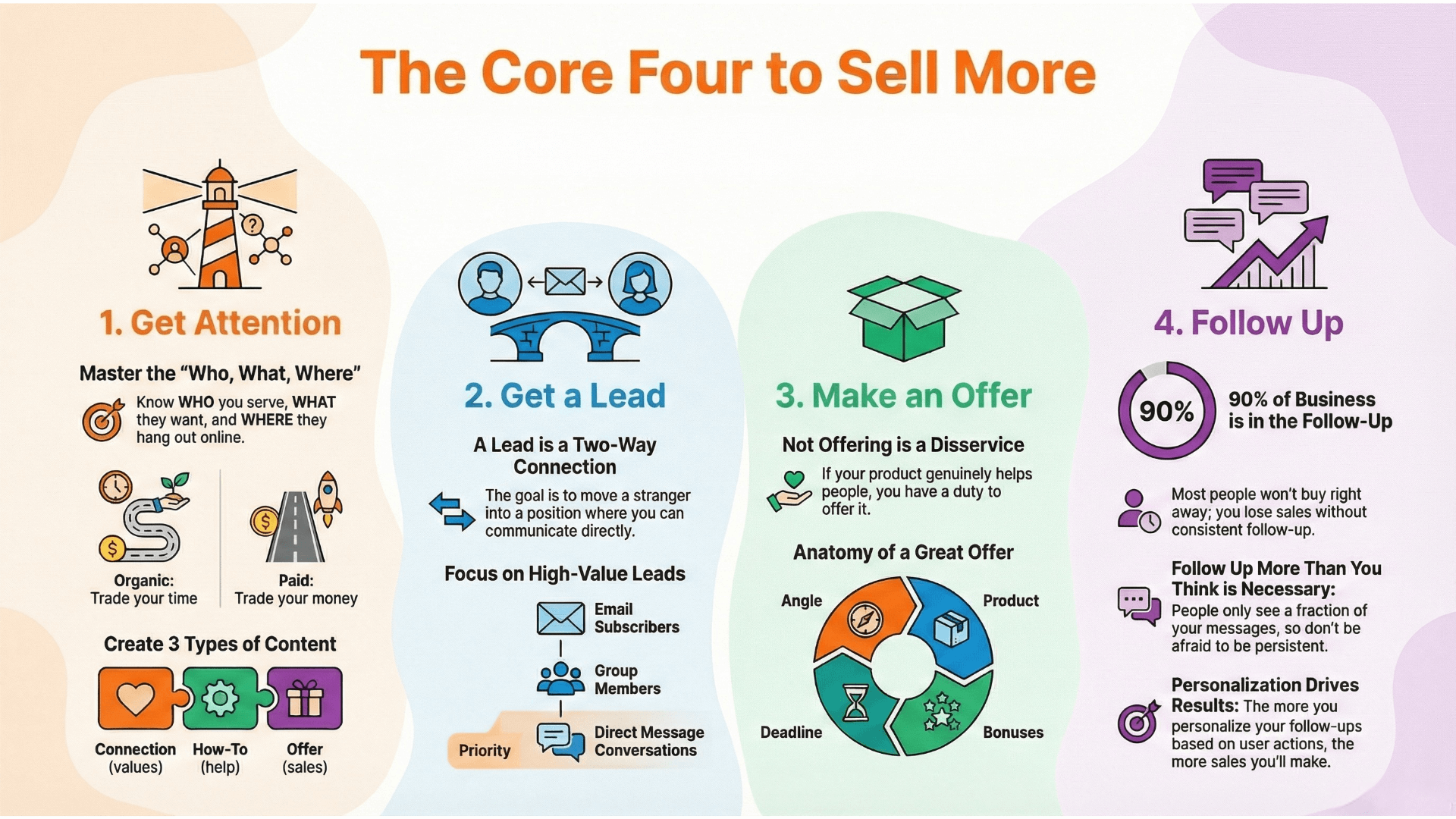
You are overwhelmed. Every marketing "expert" has a different opinion. One says you need a podcast. Another swears by TikTok. Someone else insists you need a 47-step funnel before you can make a single sale.
Stop. Take a breath.
After 25+ years of building businesses online, I have learned one simple truth: all the noise, all the complexity, all the shiny new tactics distract you from the four fundamental activities that actually generate revenue.
I call it the Core 4 Framework, and it is the simplest filter you will ever use for your marketing decisions.
Here is how it works: Every activity in your business should help you do one of these four things:
- Get Attention
- Get a Lead
- Make an Offer
- Follow Up
That is it. If what you are doing doesn't fit into one of these categories, you probably shouldn't be doing it.
Let me break down each one.
Core 4 Element #1: Get Attention
Nothing happens in your business until someone notices you exist. You can have the best product in the world, but if nobody knows about it, you will make zero sales.
The problem: Getting attention today is harder than ever. Your ideal customers are bombarded with thousands of messages daily. How do you stand out?
What Getting Attention Really Means
Getting attention is not about shouting louder than everyone else. It is about showing up in the right places with the right message for the right people.
This means you need to know:
- Who your ideal customer is (be specific, not generic)
- What problems keep them up at night
- Where they already spend their time online
Most entrepreneurs waste time trying to build an audience from scratch. Smart entrepreneurs go where their ideal customers already gather and add value there.
How to Get Attention
You have two options, and you are always trading one or the other:
Trade Your Time (Organic Marketing)
This includes posting helpful content in Facebook groups, commenting on influencer posts, creating blog posts or YouTube videos, and building relationships one conversation at a time.
The advantage? It is free. The disadvantage? It takes consistent effort to build momentum.
Trade Your Money (Paid Marketing)
This includes Facebook ads, Instagram ads, Google ads, and YouTube ads.
The advantage? It is faster and scalable. The disadvantage? It costs money and requires skill to do effectively.
The reality: Most successful businesses use both. Start with organic to learn what resonates, then amplify with paid ads once you know what works.
The Biggest Mistake People Make
Trying to get attention from everyone. When you speak to everyone, you connect with no one. The more specific you are about who you serve, the more powerful your message becomes.
Bottom line: Getting attention is the foundation. Without it, nothing else in your business can happen. Focus on showing up consistently where your ideal customers already are, and add genuine value before you ask for anything in return.
Core 4 Element #2: Get a Lead
Attention is fleeting. Someone might see your post today and forget about you tomorrow. That is why you need to convert attention into a lead, which is simply a way to communicate with someone directly.
What a Lead Really Is
A lead is not just a name in a database. It is a two-way communication channel. It is the moment someone moves from being a stranger to being a friend.
When someone gives you their email address, connects with you on social media, or reaches out via direct message, they are saying: "Yes, I want to hear more from you."
This is the bridge that turns casual attention into a real relationship.
Why Leads Matter More Than Attention
You can get 10,000 people to see your post, but if none of them become leads, you have built nothing. Attention disappears. Leads stay.
More importantly, leads give you the ability to nurture relationships over time. You can follow up, provide value, and eventually make offers when the time is right.
The Most Important Type of Lead
While there are many ways to generate leads (email subscribers, social media connections, direct messages, group members), email is your #1 priority.
Why? Because you own your email list. Social media platforms can change their algorithm overnight, or shut down your account without warning. But nobody can take your email list away from you.
If you rely only on social media and the platform changes, you lose everything. If you build an email list, you have a durable asset that you control.
How to Get Leads
The simplest way is to create something valuable and give it away for free in exchange for contact information.
This could be a PDF guide, a checklist, a video training, or a free consultation. The key is that it solves a specific problem your ideal customer has right now.
When you consistently add value through getting attention (Step 1), people will naturally want to connect with you and get more. That is when you invite them to become a lead.
The Biggest Mistake People Make
Focusing only on getting attention but never converting it into leads. They post great content but never invite people to join their email list. They get lots of likes and comments but no way to follow up.
Bottom line: Attention is the spark. Leads are the fuel. You need both. Always be moving people from attention to leads by giving them a clear next step to connect with you.
Core 4 Element #3: Make an Offer
This is where most entrepreneurs get stuck. They are good at getting attention. They are building leads. But they are terrified to actually make an offer because they don't want to be "too salesy."
Let me reframe this for you with a story:
Imagine you are a mountain climbing guide, and you are helping someone climb Mount Everest. You know they need an oxygen tank to survive at the summit. If you don't offer them the oxygen tank because you are afraid of seeming pushy, they could die.
That is how you need to think about your offers.
Making an Offer Is an Act of Service
If you genuinely believe your product or service can help someone solve their problem or achieve their goal, you have a moral obligation to tell them about it.
You are not being pushy. You are being helpful. You are shortening their journey to the result they want.
What Makes a Good Offer
A good offer has four elements working together:
- A clear hook or angle that makes it timely and relevant
- A product or service that solves a real problem
- Bonuses that increase value and remove objections
- A deadline that creates urgency to act now
Without a deadline, people will procrastinate forever. Human beings need urgency to take action. That is just how we are wired.
How Often Should You Make Offers?
Way more than you think.
A good rule of thumb: 80% of your content should include some kind of offer, whether free (join my list, watch my training) or paid (buy my product, hire me for a service).
The entrepreneurs who make the most money are not necessarily the best marketers. They are the ones who make the most offers.
The Biggest Mistake People Make
Not making enough offers because they are afraid of being salesy. They spend months building an audience and creating content but never ask for the sale.
Here is the reality: People want to be guided. They want solutions. If you help them and then show them a clear path forward, most will be grateful, not annoyed.
Bottom line: Making offers is not optional. It is the core of your business. Get comfortable asking for the sale. The more offers you make, the more sales you will close.
Core 4 Element #4: Follow Up
Here is a statistic that will change how you think about marketing:
Only 6% of people are ready to buy when you first make an offer. The other 94% need follow-up.
Let me say that another way: If you are not following up, you are leaving 94% of your revenue on the table.
Why Follow-Up Is Where the Money Is
Most people need to see an offer multiple times before they buy. They need to think about it. They need to overcome objections. They need to check their budget. They need to talk to their spouse.
And most importantly, they need to be reminded that the deadline is approaching.
If you make one offer and then move on, you miss the vast majority of people who were interested but not quite ready.
The Follow-Up Mindset Shift
Here is what holds most people back: "I don't want to annoy them."
Let me tell you the truth: The problem with your marketing is not that you are following up too much. The problem is that you are not following up enough.
Even with a highly engaged email list, only 10-20% of people will open any given email. That means 80-90% of your list won't even see your message.
If you email once about your offer, you reached maybe 15% of your list. The other 85% have no idea your offer even exists.
How to Follow Up Effectively
The most successful marketers use what I call an "aggressive deadline sequence." As the deadline for an offer approaches, they increase the frequency of their follow-up.
On the final day before a deadline expires, it is not uncommon to send 6-8 emails in the last 12 hours. Each email has a different angle, shares a different testimonial, or answers a different objection.
Does this seem like too much? Here is the reality: Most sales happen on the first day and the last day of a promotion. People procrastinate until the last minute, and then they need urgency to act.
Beyond Email: Personal Follow-Up
The most powerful follow-up is personal. When someone shows high interest in your offer (clicks your link multiple times, watches your entire video, etc.), reach out to them directly.
Send them a message: "Hey, I noticed you were checking out the program. What questions can I answer for you?"
This one-on-one conversation is where you can address specific objections and close sales that would have been lost otherwise.
The Biggest Mistake People Make
Giving up too soon. They make an offer, send one or two follow-up emails, don't see the results they want, and move on to the next thing.
Meanwhile, the people who were 90% ready to buy never got the final push they needed.
Bottom line: Follow-up is the most neglected part of marketing, and it is where 94% of your revenue hides. Follow up more than feels comfortable. Follow up until people buy or tell you no. That is where the money is.
How the Core 4 Work Together
The Core 4 is not four separate activities. It is a system where each element flows into the next.
Here is what it looks like in practice:
- You post helpful content in a Facebook group where your ideal customers hang out (Get Attention)
- People see your post, connect with you, and sign up for your free training (Get a Lead)
- At the end of your training, you invite them to buy your course (Make an Offer)
- Over the next week, you send multiple emails sharing testimonials, answering objections, and reminding them about the deadline (Follow Up)
Each step builds on the previous one. You cannot make offers without leads. You cannot get leads without attention. You cannot maximize revenue without follow-up.
The entrepreneurs who succeed are the ones who master all four elements and do them consistently over time.
The Core 4 Decision Filter
Here is how to use the Core 4 Framework to make better decisions in your business:
Before you invest time, money, or energy into any marketing activity, ask yourself:
"Does this help me Get Attention, Get Leads, Make Offers, or Follow Up?"
If the answer is no, don't do it.
Let me give you some examples:
- Spending a week redesigning your website? Probably doesn't fit. (Unless it directly helps capture leads)
- Creating a new logo? Doesn't fit.
- Posting daily in Facebook groups? Yes. (Gets attention)
- Building an email list? Yes. (Gets leads)
- Creating a new product? Yes. (Gives you something to offer)
- Writing follow-up email sequences? Yes. (Follow-up)
This simple filter will save you countless hours of wasted effort on activities that don't move the needle.
Your Next Steps: Implementing the Core 4
Understanding the framework is the first step. Now you need to implement it.
Here is what to do this week:
Step 1: Audit Your Current Activities
Look at everything you did last week. How much time did you spend on each of the Core 4 elements?
- Getting Attention: ___%
- Getting Leads: ___%
- Making Offers: ___%
- Following Up: ___%
Most people spend 80% of their time on things that don't fit into any of these categories. That is why they are not growing.
Step 2: Identify Your Weakest Link
Which of the four elements are you neglecting most?
Are you getting attention but not converting it into leads? Fix that first.
Are you building a list but never making offers? Fix that first.
Are you making offers but not following up? Fix that first.
Step 3: Do More of All Four
The secret to growing your business is not finding some magic tactic. It is simply doing more of all four Core 4 activities.
Want more leads? Get more attention.
Want more sales? Make more offers and follow up harder.
Want to grow faster? Do more of all of it.
The Bottom Line
Marketing is not complicated. We make it complicated.
The truth is, all successful businesses do the same four things:
- They get attention from the right people
- They convert that attention into leads
- They make offers to help people solve problems
- They follow up relentlessly until people buy
That is it. That is the entire game.
Technology will change. Platforms will rise and fall. New tactics will come and go.
But the Core 4 Framework will never change, because it is built on human psychology. And humans don't change that fast.
Your job is simple: Master these four elements. Do them consistently. Do more of all of them.
Stop chasing shiny objects. Stop looking for shortcuts. Stop overthinking.
Just focus on the Core 4, and watch your business grow.
Frequently Asked Questions
Q: Which of the Core 4 elements is most important?
A: They are all essential, but if I had to choose, Follow-Up has the biggest immediate impact because most people are already getting some attention and leads but failing to maximize them. That said, you need all four working together.
Q: How long does it take to see results with the Core 4 Framework?
A: If you implement consistently, you should see initial results (first leads, first sales) within 2-4 weeks. Real momentum builds over 90 days. Give yourself a full quarter to master the system.
Q: Should I focus on organic or paid marketing for getting attention?
A: Start with organic to learn what messages resonate with your audience. Once you know what works, scale it with paid ads. Paid advertising amplifies what is already working, it does not create something from nothing.
Q: How do I know if I am following up too much?
A: You are almost certainly not following up too much. The entrepreneurs who make the most money follow up far more than feels comfortable. If a few people unsubscribe, that is fine. Focus on the people who engage, not the people who leave.
Q: What if I don't have a product to sell yet?
A: Start by offering your services. If you help people with marketing, offer to do it for them. If you teach fitness, offer coaching. You can create a product later once you understand what your customers need most.
Q: Can this framework work for any type of business?
A: Yes. The Core 4 works for coaches, consultants, course creators, e-commerce, agencies, freelancers, and any business that sells to humans. It is based on psychology, not tactics, so it applies universally.
Q: How much time do I need to dedicate to implementing the Core 4?
A: At minimum, 5-10 hours per week if you are just starting. Ideally 15-20 hours if you are serious about growth. This includes creating content, engaging with your audience, making offers, and following up with leads.
Q: What if I am in a crowded, competitive market?
A: The Core 4 works even better in competitive markets. Why? Because most of your competitors will give up after a few weeks. They won't follow up enough. They won't make enough offers. If you simply execute the Core 4 consistently, you will outlast 90% of your competition.